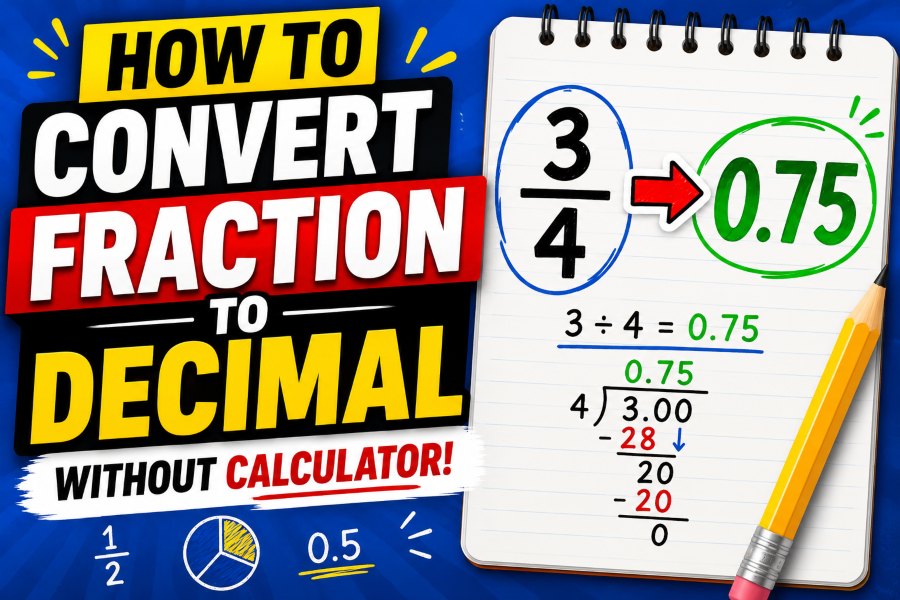
How to convert fraction to decimal without calculator is easier when you understand that every fraction is a division problem. The top number tells you what to divide, and the bottom number tells you how many equal parts make the whole.
Once you know this, you can solve common school, shopping, cooking, and measurement problems without waiting for a device. This guide shows you clear methods, simple examples, common mistakes, and smart checks that help you work faster while still understanding the math behind the answer.
Why Fractions Become Decimals
A fraction and a decimal can show the same value in two different formats. A fraction such as 1/2 shows one part out of two equal parts, while the decimal 0.5 shows the same amount using place value. You are not changing the value when you convert it, you are only changing how the value is written.
The main rule is simple. The fraction bar means divide, so 3/4 means 3 divided by 4. When you finish by hand, you may want a quick way to compare your result, and access to 300+ free online calculators gives you the freedom to run many types of calculations without replacing the learning process.
This skill matters because decimals appear often in American classrooms and daily life. Grades, money, weights, recipes, construction measurements, and sports stats often use decimals instead of fractions. In 2024 and 2025, schools also placed more focus on number sense because many students still struggled with middle-grade math after learning disruptions.
Expert quote: “A decimal is not a new number. It is the same number placed on a base-ten scale.”
How To Convert Fraction To Decimal Without Calculator
To convert a fraction to a decimal by hand, divide the numerator by the denominator. The numerator is the number on top, and the denominator is the number on the bottom. For 5/8, you divide 5 by 8, add a decimal point, add zeros, and continue until the answer ends or repeats.
Start with the top number inside the division and the bottom number outside. If the top number is smaller, write 0, place the decimal point, and add a zero to keep dividing. For 5/8, 8 goes into 50 six times, leaves 2, then 8 goes into 20 two times, leaves 4, and 8 goes into 40 five times, so 5/8 equals 0.625.
You can use this same method for nearly every fraction. It works for proper fractions, improper fractions, and mixed numbers after you prepare them correctly. A 2024 classroom trend is that teachers often ask students to explain each division step, not only write the final decimal, because explanation builds stronger number sense.
Useful steps:
- Divide the numerator by the denominator.
- Add a decimal point and zeros when needed.
- Continue until the decimal ends or repeats.
- Check whether the decimal makes sense compared with the fraction.
Use Place Value When The Denominator Fits Ten
Some fractions convert faster when the denominator can become 10, 100, or 1000. This method avoids long division and uses equivalent fractions instead. For example, 2/5 becomes 4/10 because you multiply the top and bottom by 2, so the decimal is 0.4.
This method works best with denominators such as 2, 4, 5, 8, 10, 20, 25, 50, and 100. For 3/4, you can multiply the denominator by 25 to get 100, so 3/4 becomes 75/100, which equals 0.75. It also helps with money because cents are based on hundredths.
Good place-value practice makes fraction conversion easier across measurement and unit work. If you are comparing different units after converting numbers, a free conversion calculator can support quick checks for length, weight, time, or volume while the fraction-to-decimal method still teaches the core math. This is useful because many real-life problems mix fractions with decimals and units.
Expert quote: “When a denominator can become 10, 100, or 1000, place value often beats long division for speed.”
Convert Mixed Numbers The Smart Way
A mixed number has a whole number and a fraction, such as 2 3/5. The easiest method is to keep the whole number first, then convert only the fraction part. Since 3/5 equals 0.6, the mixed number 2 3/5 equals 2.6.
You can also turn the mixed number into an improper fraction, but that may take more work. For 2 3/5, multiply 2 by 5, add 3, and place the result over 5, so you get 13/5. Then divide 13 by 5 to get 2.6, which proves both methods match.
This matters in algebra because mixed numbers often appear inside equations, ratios, and word problems. When your work grows beyond basic arithmetic, a free algebra calculator can help you test expressions or compare answers, but you still need to understand how the decimal was created. In 2025, many math-help searches centered on step-by-step tools because students wanted explanations, not only final answers.
Use the whole-number method when the fraction part is simple. Use the improper-fraction method when the mixed number appears inside a longer calculation. Both methods are correct when you divide in the right order.
Handle Improper Fractions Clearly
An improper fraction has a numerator larger than the denominator, such as 7/4 or 11/5. The decimal answer will be greater than 1 because the top number contains more than one full group. For 7/4, divide 7 by 4 and you get 1.75.
You can also break the fraction into a whole part and a leftover part. Since 4 fits into 7 one time with 3 left over, 7/4 becomes 1 3/4. Then convert 3/4 into 0.75, and the final answer becomes 1.75.
This approach helps you avoid answers that are too small. If 7/4 becomes 0.75 in your work, you know something went wrong because 7/4 is more than one whole. In 2024 math intervention lessons, estimation became a key step because students often made calculation errors that a quick size check could catch.
Expert quote: “Before you divide, estimate the size of the answer. The estimate protects you from obvious mistakes.”
Understand Terminating Decimals
A terminating decimal ends. Fractions such as 1/2, 3/4, 5/8, and 7/10 become decimals that stop after a certain number of digits. For example, 1/2 equals 0.5, 3/4 equals 0.75, and 5/8 equals 0.625.
A fraction usually terminates when the simplified denominator has only 2s and 5s as prime factors. This happens because our decimal system is based on 10, and 10 is made from 2 times 5. That is why denominators like 2, 4, 5, 8, 10, 20, 25, 50, and 100 often convert cleanly.
You do not need advanced factor work every time, but the idea helps you predict the answer. If the denominator is 8, the decimal will end because 8 is 2 × 2 × 2. If the denominator is 3, 6, 7, 9, or 11, you should expect a repeating decimal in many cases.
This prediction saves time during tests. It also helps you decide when to stop dividing and when to mark a repeating pattern. A strong answer includes both the decimal and a clear understanding of why it stops.
Understand Repeating Decimals
A repeating decimal continues forever with a digit or group of digits repeating. For example, 1/3 equals 0.333…, and 2/9 equals 0.222…. These decimals do not end because the division keeps producing the same remainder.
When you divide 1 by 3, 3 goes into 10 three times with 1 left over. The same remainder appears again, so the same digit repeats again. This is how you know the decimal pattern will continue.
Some repeating decimals have a longer pattern. For example, 1/7 equals 0.142857142857…, where the digits 142857 repeat. You do not need to write the pattern forever, but you should show it clearly with dots or a repeat bar if your class allows that notation.
Repeating decimals matter because rounding changes the exact value. If you write 1/3 as 0.33, that is only an estimate, not the exact decimal. In 2024 and 2025 digital-learning trends, students used more auto-check tools, but teachers still emphasized showing repeating notation because exactness matters in math.
Use Long Division Without Fear
Long division feels hard when you treat it as a memory trick. It becomes easier when you follow a steady rhythm: divide, multiply, subtract, bring down, and repeat. Each new zero after the decimal gives you another chance to divide.
Take 3/8 as an example. Eight does not fit into 3, so you write 0, add the decimal point, and make 3 into 30. Eight fits into 30 three times, leaves 6, then fits into 60 seven times, leaves 4, and fits into 40 five times, so 3/8 equals 0.375.
Use lined paper if the digits shift around too much. Keep the decimal point straight above the decimal point in the dividend. Many wrong answers come from poor spacing, not poor understanding.
Expert quote: “Long division is a layout skill as much as a number skill. Clean writing leads to cleaner answers.”
Good habits:
- Write one digit per space.
- Keep decimal points aligned.
- Bring down one zero at a time.
- Stop only when the decimal ends or the pattern repeats.
Estimate Before You Calculate
Estimation tells you what kind of answer to expect. If the fraction is less than 1, the decimal should also be less than 1. If the fraction is greater than 1, the decimal should also be greater than 1.
For 4/5, you know the answer should be close to 1 because 4 is close to 5. The exact answer is 0.8, which makes sense. For 1/8, you know the answer should be much smaller than 1/2, and the exact answer is 0.125.
This simple habit catches many mistakes. If you divide 1/8 and get 1.25, the answer is too large because one eighth is smaller than one whole. If you divide 9/10 and get 0.09, the answer is too small because nine tenths is close to one whole.
Estimation also helps with test confidence. You do not need to guess blindly when you understand the size of the fraction. In recent math classrooms, number-line reasoning has become more common because it helps students see whether decimals and fractions match the same point.
Avoid Common Mistakes
The biggest mistake is dividing the denominator by the numerator. For 3/4, you must divide 3 by 4, not 4 by 3. If you reverse the order, you get 1.333…, which is not equal to 3/4.
Another mistake is forgetting the zero before the decimal. When the numerator is smaller than the denominator, the decimal begins with 0. This is why 1/4 is 0.25, not 25.
Students also stop too early with repeating decimals. If the remainder keeps repeating, the decimal does not end. You should write the repeating pattern clearly instead of pretending the number stopped.
Rounding without permission is another problem. If a question asks for an exact decimal, keep the repeating notation. If it asks for the answer to the nearest hundredth, then rounding is allowed.
Common errors to check:
- Reversed division order.
- Missing decimal point.
- Poor long-division alignment.
- Stopping before a repeat is clear.
- Rounding when the question wants an exact value.
Convert Decimals Back To Fractions
Converting decimals back to fractions helps you check your work. A decimal in the tenths place goes over 10, a decimal in the hundredths place goes over 100, and a decimal in the thousandths place goes over 1000. For example, 0.7 becomes 7/10.
For 0.25, the 25 is in the hundredths place, so the fraction is 25/100. Then simplify by dividing the top and bottom by 25. The final fraction is 1/4.
For 0.625, the 625 is in the thousandths place, so it becomes 625/1000. Divide both numbers by 125, and you get 5/8. This proves that 5/8 and 0.625 are the same value.
This reverse method is useful when you want to confirm a decimal answer from division. If your fraction was 3/4 and your decimal was 0.75, turning 0.75 into 75/100 gives 3/4 after simplification. A two-way check builds accuracy and helps you trust your answer.
Quick Fraction To Decimal Examples
The fastest way to improve is to practice common fractions until they feel familiar. You do not need to memorize every fraction, but some conversions appear so often that knowing them saves time. These include halves, quarters, fifths, eighths, and tenths.
Common examples:
- 1/2 = 0.5
- 1/4 = 0.25
- 3/4 = 0.75
- 1/5 = 0.2
- 2/5 = 0.4
- 3/5 = 0.6
- 4/5 = 0.8
- 1/8 = 0.125
- 3/8 = 0.375
- 5/8 = 0.625
- 7/8 = 0.875
These conversions are common in cooking, construction, schoolwork, and shopping. For example, a recipe may use 3/4 cup, but a digital scale or nutrition tool may show decimals. If you know that 3/4 equals 0.75, you can move between formats without confusion.
Practice with one family of fractions at a time. Start with halves and quarters, then move to fifths and eighths. This approach is cleaner than memorizing a random list.
When To Round Your Decimal
Rounding depends on what the question asks. If a decimal terminates, you can write the exact answer without rounding. If the decimal repeats, you may need to round to a certain place, such as the nearest tenth, hundredth, or thousandth.
For 2/3, the exact decimal is 0.666…, but rounded to the nearest hundredth, it becomes 0.67. You look at the third decimal digit to decide whether the second decimal digit increases. Since the third digit is 6, the hundredths digit rounds up.
Rounding is common in money, measurements, and test instructions. In money, answers usually stop at two decimal places because cents use hundredths. In science and engineering, the number of decimal places often depends on the precision of the measurement.
Do not round too early when solving a longer problem. Keep extra digits during the middle steps, then round at the end. This reduces small errors that can grow into larger wrong answers.
Conclusion
How to convert fraction to decimal without calculator becomes simple when you remember that the fraction bar means division. You divide the numerator by the denominator, use zeros after the decimal when needed, and continue until the decimal ends or repeats. You can also use place value when the denominator can become 10, 100, or 1000, which makes many common fractions faster to solve.
Mixed numbers, improper fractions, terminating decimals, and repeating decimals all follow the same basic logic once you understand the size of the number. Build the habit of estimating first, dividing carefully, and checking your result by converting the decimal back to a fraction. With practice, you will not only get the right answer, you will understand why the answer makes sense.
FAQs
What Is The Easiest Way To Convert A Fraction To A Decimal?
The easiest way is to divide the numerator by the denominator. For example, 3/4 means 3 divided by 4, which equals 0.75. This method works for almost every fraction.
How Do You Convert A Fraction To A Decimal Without Long Division?
You can change the denominator to 10, 100, or 1000 when possible. For example, 2/5 becomes 4/10, so the decimal is 0.4. This method works best with friendly denominators.
Why Does The Numerator Go Inside The Division?
The fraction bar means the top number is divided by the bottom number. In 5/8, the 5 goes inside and the 8 goes outside. Reversing the order gives the wrong value.
What Is A Terminating Decimal?
A terminating decimal is a decimal that ends. Examples include 0.5, 0.75, and 0.625. These usually come from simplified denominators made only of 2s and 5s.
What Is A Repeating Decimal?
A repeating decimal has a digit or group of digits that continues forever. For example, 1/3 equals 0.333…. The repeated remainder during division creates the repeated decimal pattern.
How Do You Convert 3/8 To A Decimal?
Divide 3 by 8 using long division. Add zeros after the decimal and continue dividing. The answer is 0.375.
How Do You Convert 7/4 To A Decimal?
Divide 7 by 4. Four fits into 7 one time, and the remaining part becomes 0.75. The final answer is 1.75.
How Do You Convert A Mixed Number To A Decimal?
Keep the whole number and convert the fraction part. For 2 1/4, convert 1/4 to 0.25. The answer is 2.25.
Should I Round Repeating Decimals?
Round only when the question asks for it. If it asks for an exact value, use repeating notation. If it asks for the nearest hundredth, round to two decimal places.
How Can I Check My Decimal Answer?
Convert the decimal back to a fraction. For example, 0.75 becomes 75/100, which simplifies to 3/4. If it matches the original fraction, your answer is correct.
Why Is 1/2 Equal To 0.5?
One divided by two equals one half of a whole. In decimal form, half of 1 is 0.5. Both forms show the same value.
Why Is 1/4 Equal To 0.25?
One divided by four gives 0.25. You can also think of 1/4 as 25/100. Since 25 hundredths equals 0.25, both answers match.
Can Every Fraction Become A Decimal?
Yes, every fraction can be written as a decimal. The decimal will either terminate or repeat. It will not create a random endless pattern without repetition.