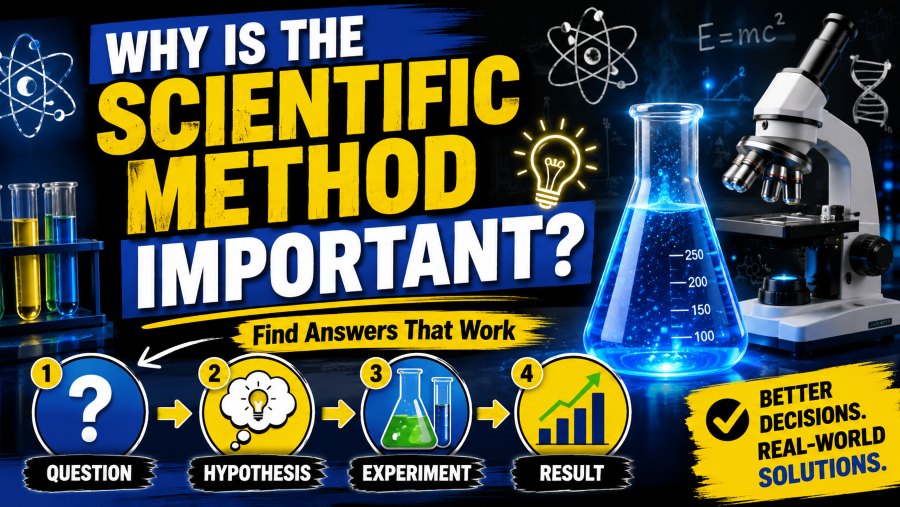
Why is the scientific method important? It matters because it gives you a clear way to test ideas instead of trusting guesses, opinions, rumors, or personal bias. When you use observation, questions, hypotheses, experiments, data, and review, you move closer to reliable answers.
The scientific method is not only for scientists in white coats. You use the same logic when you compare products, check health claims, test study habits, or ask whether something is actually true. This process protects your thinking, sharpens your judgment, and helps you make decisions based on evidence instead of noise. Read on!
Why Is The Scientific Method Important For Reliable Answers
The scientific method is important because it turns curiosity into a structured search for truth. You start with an observation, ask a focused question, make a testable hypothesis, collect data, and compare the results with your original idea. That order keeps you from jumping to conclusions before the evidence is strong enough.
This matters even more today because information spreads fast, but not all information is tested. In 2026, Pew Research Center reported that 77% of U.S. adults had at least a fair amount of confidence in scientists, yet that trust remained below the early COVID-19 level of 87%. (Pew Research Center) Trust grows when people can see how evidence was collected, checked, and corrected.
Scientific thinking also helps you compare numbers, measurements, and results without guessing, and when you need quick calculations outside a lab, access 300+ free online calculators gives you a tool-based way to check math instead of relying on memory. That same habit matters in experiments because accurate numbers protect your conclusion from weak assumptions. The point is simple: good answers need clear methods.
How The Scientific Method Reduces Bias
Bias is one of the biggest reasons the scientific method matters. You may want one answer to be true, but wanting does not make it true. A good method forces you to test the idea against evidence that can disagree with you.
Confirmation bias happens when you notice supporting facts and ignore facts that challenge your belief. The scientific method fights that habit by requiring controlled tests, repeatable steps, honest measurement, and clear reporting. It does not remove every human weakness, but it makes weakness easier to find.
The National Science Board reported in 2024 that 60% of American adults understood basic research ideas such as the value of a control group, but only 50% could correctly identify a scientific hypothesis. That gap shows why the method is still important in education, news, health, business, and daily decision-making. You need more than confidence. You need a process.
Why Testing Matters More Than Guessing
A guess can start the process, but it cannot finish it. A hypothesis becomes useful only when you can test it, measure it, and compare it with real results. Without testing, even a smart idea stays uncertain.
This is why science separates belief from evidence. If a student thinks a new study routine improves grades, that idea needs a fair test with time, scores, and comparison. A scientific calculator supports this kind of work when you need functions, equations, or precise numerical checks during science, math, or data tasks.
Testing also makes failure useful. When results do not support your hypothesis, the method does not treat that as wasted effort. It gives you a better question, a sharper design, and a clearer path forward.
Why Measurement Makes Evidence Stronger
Measurement gives science its backbone. You can describe an observation with words, but numbers help you compare, repeat, and verify what happened. Clear measurement also lets another person test your claim without depending on your memory.
Small errors can create big misunderstandings. A wrong unit, weak scale, poor sample, or unclear variable can change the meaning of an experiment. A free conversion calculator helps readers handle unit changes more carefully, which matters because accurate conversions protect measurements from simple but costly mistakes.
In 2024, the NAEP science assessment reported that the average eighth-grade science score was 4 points lower than in 2019 and not significantly different from 2009. That trend shows why students need stronger practice with evidence, measurement, and scientific reasoning. Science education is not only about facts. It is about learning how facts are checked.
Why The Method Helps Science Correct Itself
Science improves because it can admit when it is wrong. A claim may look strong today, but new data can challenge it tomorrow. The scientific method gives researchers a way to revise ideas without treating correction as failure.
This self-correcting nature protects the public record. Retraction Watch reported that its database had more than 65,000 retractions, which shows that published research can still be corrected when errors, misconduct, or weak evidence appear. That is not a reason to reject science. It is a reason to value transparent correction.
A strong method also separates serious research from confident storytelling. If another team cannot repeat the result, the claim becomes weaker. If several teams repeat it under fair conditions, the claim becomes stronger.
Why The Scientific Method Is Not A Rigid Recipe
Many people learn the scientific method as a straight list of steps. Real research is often messier than that. Scientists may move back and forth between observation, data, questions, methods, and new hypotheses.
That flexibility does not make the method useless. It makes it realistic. The core idea stays the same: you ask a testable question, collect evidence, analyze results, and stay willing to revise your explanation.
This is why the scientific method works as a thinking framework, not just a classroom diagram. A field scientist, medical researcher, engineer, and climate analyst may use different tools, but they still rely on evidence. The steps may bend, but the standard remains clear.
Why Peer Review And Repetition Matter
One experiment rarely settles everything. Strong science needs review, repetition, and criticism from people who can spot flaws. Peer review helps catch weak logic, unclear methods, missing data, and unsupported conclusions before claims spread too far.
Repetition is just as important. If a result appears once but disappears when another team repeats the test, you should treat it carefully. Reliable findings survive pressure from new data, better tools, and independent researchers.
A 2025 analysis of CrossRef data found that scholarly publications doubled about every 9.8 years, while retractions doubled about every 11.4 years and preprints grew even faster. That growth makes quality control more important, not less. The more science produces, the more carefully you need to test, review, and correct it.
Why The Scientific Method Matters In Daily Life
You do not need a laboratory to use scientific thinking. You use it when you compare two diets, test whether a productivity app helps, or ask whether a viral claim has real evidence. The method gives you a practical way to slow down and check what is true.
This habit protects you from bad advice. If someone says a supplement, gadget, or routine works for everyone, you can ask what was tested, who was studied, how results were measured, and whether other evidence supports the claim. Those questions make you harder to mislead.
Scientific thinking also improves ordinary decisions. You learn to look for patterns, compare causes, and separate one-time events from real trends. That skill is useful at school, at work, at home, and online.
Why The Method Supports Better Public Decisions
Public decisions need more than emotion. Health policy, weather planning, food safety, transportation, farming, and environmental protection all depend on evidence. The scientific method gives decision-makers a way to compare risks, benefits, and trade-offs.
The United States performed an estimated $885.6 billion in research and development in 2022, according to Science and Engineering Indicators data published in 2024. That level of investment shows how deeply modern society depends on tested knowledge. Research supports medicine, technology, agriculture, energy, defense, and education.
Bad evidence can produce expensive mistakes. Good evidence helps leaders act with more confidence and less guesswork. You may not agree with every policy choice, but the best public choices still need tested facts.
Why Students Need The Scientific Method Early
Students need the scientific method because it teaches them how to think, not only what to remember. Facts are useful, but the ability to question facts is stronger. When students learn how evidence works, they become better readers, writers, problem-solvers, and citizens.
The OECD’s PISA 2022 results, released in recent years, showed that one in four 15-year-olds across OECD countries was a low performer in mathematics, reading, and science. That trend matters because weak science reasoning affects future careers and daily choices. Students need practice with evidence before misinformation becomes a habit.
Science class should not feel like memorizing definitions. It should train students to ask better questions, design fair tests, read data, and explain results. Those skills carry into every serious field.
Why Expert Judgment Still Needs Evidence
Experts matter, but expertise does not replace evidence. A trained scientist can ask better questions and avoid common mistakes, but the claim still needs data. The scientific method keeps expert judgment tied to proof.
As physicist Richard Feynman famously warned, the first principle is that you must not fool yourself. That idea sits at the heart of scientific work. Smart people can fool themselves when they want a result too badly.
Carl Sagan also captured the standard clearly when he said that extraordinary claims require extraordinary evidence. In plain terms, the bigger the claim, the stronger the proof should be. The scientific method gives you that standard without drama.
Why The Scientific Method Protects Against Misinformation
Misinformation often sounds simple, emotional, and certain. Science is usually more careful because it must explain how it knows what it knows. That difference matters when you read health posts, product claims, political arguments, or viral videos.
A 2024 arXiv dataset on withdrawn papers included more than 14,000 withdrawn arXiv papers and grouped withdrawal reasons into 10 categories. That kind of work shows how much attention modern research now gives to error detection and quality control. The same mindset helps you judge online claims.
You can ask simple scientific questions when you see a claim. What is the evidence? Who tested it? Was there a control group? Can another source confirm it? Those questions make false certainty weaker.
Why The Scientific Method Important For Future Innovation
Why is the scientific method important for future innovation? It helps people build new ideas on tested knowledge instead of weak assumptions. Every serious invention needs trial, error, measurement, and correction.
Universities reported $117.7 billion in higher education research and development spending in FY 2024, an 8.1% increase from FY 2023. That investment depends on methods that can separate promising ideas from unsupported claims. Innovation moves faster when researchers know which paths failed and which results can be trusted.
This is why the method remains useful in medicine, AI, engineering, agriculture, and climate research. New tools will change how science works, but they will not remove the need for evidence. Better technology still needs better testing.
Conclusion
Why is the scientific method important? It is important because it gives you a disciplined way to move from curiosity to evidence, and from evidence to better decisions. It reduces bias, strengthens measurement, supports repeatable testing, and helps people correct mistakes before they become accepted as truth.
The method also protects you in daily life. It teaches you to ask what was tested, how it was measured, whether the result was repeated, and whether the conclusion truly follows the data. That habit matters in science class, online research, health choices, business decisions, and public policy.
The scientific method is not perfect, and real research is not always neat. Still, it remains one of the best tools humans have for finding reliable answers in a noisy world.
FAQ
What Is The Scientific Method
The scientific method is a structured process for asking questions, forming hypotheses, testing ideas, collecting data, and drawing conclusions. It helps you move from opinion to evidence. It also gives other people a way to review or repeat your work.
Why Is The Scientific Method Important In Simple Words
The scientific method is important because it helps you find out what is true. It keeps you from trusting guesses too quickly. It also helps you change your mind when better evidence appears.
What Are The Main Steps Of The Scientific Method
The main steps are observation, question, hypothesis, experiment, data analysis, conclusion, and communication. Some projects use these steps in a different order. The important part is testing ideas with evidence.
Why Is A Hypothesis Important
A hypothesis gives you a testable explanation. It turns a broad question into something you can check. Without a hypothesis, an experiment can become unfocused.
How Does The Scientific Method Reduce Bias
It reduces bias by forcing you to use clear steps, fair tests, and measurable results. It also encourages peer review and repetition. These checks make it harder for personal belief to control the conclusion.
Is The Scientific Method Always Linear
No, real science is often not linear. Scientists may return to earlier steps when new evidence appears. The process stays useful because it keeps the focus on testing and correction.
Why Are Control Groups Important
Control groups help you compare what happens with and without the tested factor. They make it easier to see whether the treatment caused the result. Without a control group, the conclusion can be weak.
Why Is Repeatability Important In Science
Repeatability shows whether a result can happen again under similar conditions. If other researchers repeat the test and get similar results, the claim becomes stronger. If they cannot, the claim needs more review.
Can The Scientific Method Be Used In Daily Life
Yes, you can use it in daily life when you test habits, compare choices, or check claims. You observe a problem, try one change, track the result, and decide what worked. This helps you make practical decisions.
What Is The Difference Between A Hypothesis And A Theory
A hypothesis is a testable idea. A theory is a broad explanation supported by repeated evidence. In science, a theory is not a random guess.
Why Does Science Change Over Time
Science changes because new evidence appears. Better tools, better data, and better experiments can improve old explanations. This change is a strength, not a weakness.
Why Should Students Learn The Scientific Method
Students should learn it because it builds critical thinking. It teaches them how to ask better questions, check evidence, and explain results. Those skills help in school, work, and everyday life.